

About the WFH Guidelines for the Management of Hemophilia
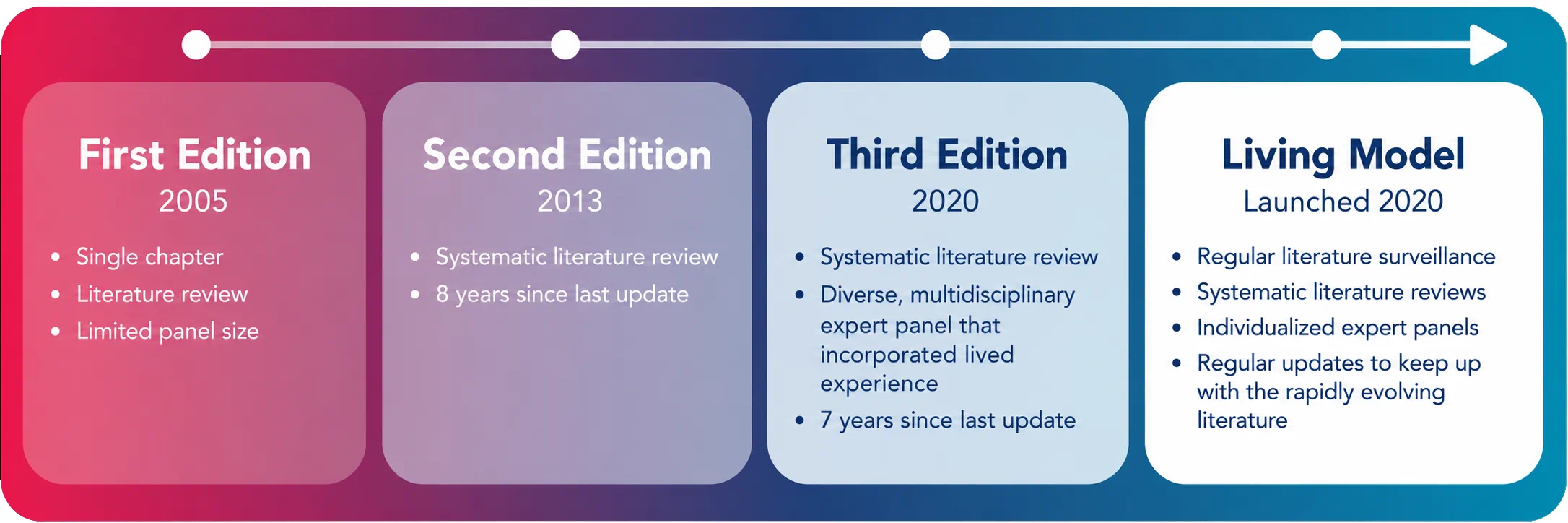
The World Federation of Hemophilia (WFH) developed the first edition of the Guidelines for the Management of Hemophilia in 2005. These guidelines were updated in 2012 and again in 2020 and have since been distributed globally in print and online.
For the third edition (2020), the WFH modified the development method, incorporating evidence-based and Trustworthy Consensus-Based Statement (TCBS) approaches alongside established international standards for clinical practice guidelines to create an evidence-based and consensus-driven approach.
Guideline panels are composed of hemophilia experts from around the world, including individuals with lived experience. The process includes structured clinical question development, application of the PICO methodology, systematic literature reviews and appraisal and synthesis of the evidence, complemented by expert clinical input. This ensures that recommendations are scientifically robust, clinically meaningful, and relevant across diverse global settings.
In 2020, the WFH announced that future guidelines would incorporate a Living Guideline Model (LGM), to ensure that recommendations are updated as new evidence emerges and remain relevant for the global hemophilia community. The LGM model is supported by increased transparency in the development process, a formalized Evidence-to-Decision (EtD) Framework, and enhanced supplemental materials including educational tools and webinars. All guidelines content and supporting resources are now integrated into this new Guidelines Hub, providing streamlined access to the full development process and the most up-to-date recommendations.
- Single chapter
- Literature review
- Limited panel size
- Systematic literature review
- 8 Years between updates
- Systematic literature review
- Diverse, multidisciplinary expert panel that incorporated lived Experience
- 7 years since last update
- Regular literature surveillance
- Systematic literature reviews
- Individualized expert panels
- Regular updates to keep up with the rapidly evolving literature
- Systematic literature review
- Diverse, multidisciplinary expert panel that incorporated lived Experience
- 7 years since last update
- Regular literature surveillance
- Systematic literature reviews
- Individualized expert panels
- Regular updates to keep up with the rapidly evolving literature
Governance
The development of treatment guidelines is a fundamental activity of the World Federation of Hemophilia (WFH). The WFH Guidelines for the Management of Hemophilia have evolved into a living model, where guideline topics are updated on a predefined schedule (eg. every 1, 2, 3, or 5 years) with each update taking approximately one year to complete. The WFH depends on our Committee and Panel members to reach decisions objectively, without being influenced or appearing to be influenced by conflicting interests. It is imperative for the WFH to safeguard the integrity of the WFH Treatment Guidelines process and to preserve the community trust in and reliability of the recommendations.
Guidelines Steering Committee
The Steering Committee oversees the strategic direction of the WFH Treatment Guidelines. Members are responsible for selecting topics for update, recommending and approving of new guideline topics, recommending topic panelists, and reviewing all guidelines prior to publication. The Steering Committee is chaired by the WFH Vice President, Medical. Members of the steering committee are permitted to serve as panelists.
Cedric Hermans (Europe) (Chair)
MD, PhD
Amy Dunn (USA, MASAC)
MD
Magdalena Lewandowska (USA)
MD
Johnny Mahlangu (Africa)
BSc, MBBCh, MMed, FCPath
Margareth Ozelo (Brazil)
MD, PhD
Glenn Pierce (USA)
MD, PhD
Alok Srivastava (India)
MD, FRACP, FRCPA, FRCP
St. Johns Research Institute
Senior Consultant, Department of Clinical Haematology
St. John’s Medical College Hospital
St. John’s National Academy of Health Sciences
Koramangala, Bengaluru, India
Guidelines Oversight Committee (GOC)
The GOC is an independent body responsible for ensuring the integrity, transparency, and methodological rigor of the guideline development process, including oversight of panelist conflicts of interest. The GOC is responsible for evaluating qualified candidates and approving their role as a Topic Panelist, Topic Lead, or Steering Committee Member.
Kate Khair
PhD
Centre for Outcomes and Experience Research in Child Health Illness and Disability Research Unit (ORCHID) and Great Ormond Street Hospital for Children, London, UK
Mark Skinner
JD
President and CEO, Institute for Policy Advancement Ltd, United States Assistant Professor, Department of Health Research Methods, Evidence and Impact at McMaster, Ontario, Canada
Clive Smith
Lived Experience Expert
London, England
Enrique David Preza Hernancez
Lived Experience Expert
Mexico City, Mexico
Methodology and Evidence Synthesis Team
The WFH Treatment Guidelines are supported by the Cardiovascular Research Methods Centre (CRMC) at the University of Ottawa Heart Institute, which provides specialized expertise in guideline methodology, systematic reviews, and evidence synthesis.
Working in collaboration with WFH and the guideline topic panels, the Methodology and Evidence Synthesis Team supports the full evidence-to-recommendation process. This includes refining clinical questions and PICO frameworks; developing and conducting systematic reviews; identifying, appraising, and synthesizing the evidence; preparing evidence summaries and Evidence-to-Decision (EtD) frameworks; and providing methodological guidance for the development and consensus of guideline recommendations.
The team also supports the Living Guidelines Model, including ongoing evidence surveillance and the systematic updating of evidence and recommendations as new evidence emerges. This partnership helps ensure that WFH Treatment Guidelines are developed and updated using rigorous, transparent, consistent, and reproducible methods.
George A. Wells
PhD, Methodology Lead
Professor, School of Epidemiology and Public Health, University of Ottawa
Director, Cardiovascular Research Methods Centre, University of Ottawa Heart Institute
Professor, Department of Medicine, University of Ottawa
Shannon Kelly
PhD, Methodology Lead
Program Manager and Senior Research Methodologist, Cardiovascular Research Methods Centre, University of Ottawa Heart Institute
Adjunct Professor, School of Epidemiology and Public Health, University of Ottawa
WFH Staff Team
The WFH Staff Team provides planning, development, and procedural support for the Guidelines, and is comprised of the WFH Director of Data and Research, guidelines methodology, systematic review and medical communications experts, and administrative support staff. The WFH Staff Team works in close collaboration with the Topic Panel and is also responsible for collecting COIs, panelist agreement forms, as well as coordinating with the steering committee and guidelines oversight committee
Topic Panelists
The WFH Guidelines Panels are topic specific. Each panel is composed of a Panel Lead and/or Co-Lead, along with
expert clinicians, other healthcare professionals relevant to the topic area, and includes representation from people living
with hemophilia and/or caregivers.
WFH Guidelines Panels are designed to reflect diversity across a range of variables, which may vary in importance depending on the panel topic. These variables include clinical expertise, gender, geographical and economic contexts, age, and disease subtypes or severities.
There is no pre-determined minimum or maximum number of panelists, allowing for flexibility based on the needs of the specific chapter.
Expectations for Topic Panelists
All WFH Guidelines Panel members are expected to be active participants, attend all panel meetings (in-person or virtual), and contribute to the discussions. They are expected to collaborate with other panel members, methodologists, and WFH support staff to finalize guidelines. People with hemophilia and caregivers are expected to provide input based on their lived experience. Panel members are expected to review all materials that are provided to them prior to meetings.
For new chapters or chapter updates, panel members are expected to provide input on the search strategy and to review and evaluate all evidence provided to them by the Methodology Group.
During the development of recommendations, panel members contribute to the formulation of recommendations, ensuring they are clear, actionable, and evidence based. Panel members should actively participate during the voting process for each recommendation and provide constructive feedback on draft documents.
Responsibilities For Topic Leads
In addition to the general responsibilities of WFH Guidelines Panel Members, Panel Leads and Co-Leads are expected to assume leadership roles that ensure the panel operates effectively and efficiently. Specifically, Topic Leads and are expected to:
- Facilitate panel discussions
- Ensure that panelists who are people with hemophilia or caregivers have an opportunity to participate
- Assist with drafting the background and rationale for each recommendation
Conflicts of Interest Policy
WFH Guideline Panel and Steering Committee members are chosen because of their high level of content expertise in the subject matter. Content experts are essential to the development of clinical practice guidelines, especially in rare disease, where their specialized knowledge and experience can often fill gaps in the evidence where quality data are limited. The WFH recognizes that many WFH Guideline Panel Members have relationships with industry or organizations, and that many, as faculty members of hemophilia treatment centres, hospitals, and universities, have professional obligations to be actively involved in research activities that will require funding, and will often be funded by industry. However, these financial conflicts have the potential to introduce bias into the guidelines process and therefore must be carefully managed.
Similarly, lived experience experts (LEEs) are essential to ensure that guidelines are aligned with real-world needs and are sensitive to the burdens and trade-offs that patients face. However, LEEs may have strong preferences or expectations based on their personal experiences, needs, and desires. These COIs must also be considered.
Each panel member is required to provide a completed Conflict of Interest (COI) form, that will then be updated prior to Delphi voting. All disclosures will be reviewed by the GOC and anyone deemed to have a meaningful conflict of interest may be disqualified (significant conflict) in accordance with the WFH COI Policy. Panelists are expected to verbally confirm their COIs and disclose any new COIs at the start of each meeting. Failure to provide full and accurate disclosures will result in removal from the guideline process.
COIs that result in disqualification include: 1) employee, officer, or director of a commercial entity; 2) officer or director of an entity that has a financial relationship with a commercial entity with a vested interest in the guideline topic; and 3) holds patent rights related to the guideline topic and directly receives royalties.
Public Comment, External Review, and Peer Review
Starting in 2026, all guidelines undergo a Public Comment Period and a Formal External Review process. During the Public Review, the WFH invites healthcare professionals, people with bleeding disorders, caregivers, patient organizations, researchers, industry representatives, government officials, and other stakeholders to provide feedback on the draft guidelines. The purpose of this public comment period is to gather diverse perspectives and ensure that the guidelines are scientifically rigorous, globally relevant, practical, and responsive to the needs of people with bleeding disorders across different healthcare settings. Additionally, Submission of comments does not guarantee incorporation into the final version; however, all feedback will be reviewed and considered by the guideline panel and methodology team.
During the External Review, key experts in the field who are not panelists will be selected and invited to provide input on the full draft of the guidelines. The purpose of this review is to gather additional expert opinion on the recommendations both individually, and as whole, and how they may function in diverse clinical settings.
The public comment and external review may run simultaneously, and for both, all documents are confidential drafts, meaning they are provided soley for consultation purposes and should not be distributed, cited, reproduced, or used for clinical decision making for any reason and may undergo revision following review.
The final version of the guidelines will also undergo the Journal’s rigorous peer review process.